Red Hat Content Management Solution
Organizations need powerful solutions to manage their growing content needs. Many companies need a solution today, and in tight market conditions, can't spend the money for a long-term, million dollar content management system implementation. But, these companies also can't be constrained to the limited functionality and limited potential for customization and future extension of most lower-priced solutions.
Part of Red Hat's Content and Collaboration Management Software Solutions (CCM), the Red Hat Content Management Solution (CMS) can offer a company all the Web content management functionality needed now, with the flexibility to tailor a deployment to the specific production environments and processes of each organization. As the needs of the organization grow, additional functionality can be integrated through other Red Hat CCM applications, including advanced content management and collaboration.
Red Hat CMS uses a solution-centered approach that can have a company running a content management system in as few as two months. Because of our open source business model, customers invest in optimal system configuration and the ideal service and support model to meet the needs of the organization. Additionally, if specific customizations are required, our team of technology and service professionals are ready to deliver. Red Hat CMS is delivered with the source code and is J2EE compliant, allowing easy extensibility and customization of the implementation by Red Hat, or by the organization's own developers.
Technology & Experience
Red Hat CMS provides end-to-end functionality for managing all types of Web content. It is built on extensible, task-oriented components that developers and publishers can easily tailor to the specific requirements of any size organization. Red Hat CMS establishes clearly defined roles and documented workflow processes. Underneath this lies the Red Hat CCM Core, the platform that houses the Content Repository and powerful version control capabilities to enable re-use and re-targeting of content so that large corporations can communicate effectively with employees, partners and customers in less time and with more savings than previously available.
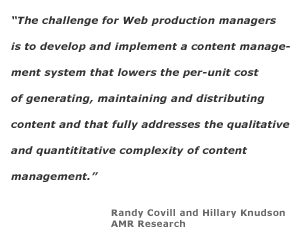
 To be truly flexible, a system must offer extensibility and control beyond the "customization" offered by a closed-source or an out-of-the-box system. An organization must be able to extend and adapt a content management system to its specific needs, otherwise it will find its production environment adapting to the constraints of the content management system, which is neither efficient nor productive. An organization must also be able to make future changes and adaptations without requiring the involvement of external professional service teams. In short, a content management system must allow an organization complete control of functionality.
Though the basic requirements for content management are the same between organizations, the production environments can be drastically different. A CMS must be flexible enough to adapt to the needs of each production environment. Large organizations can also have drastically dissimilar internal production environments in different divisions or departments. To handle this, a CMS needs the ability to configure one installation for multiple product ion environments.
The Red Hat CMS Difference. Red Hat CMS allows different "instances" of the application to be mounted under the different "managed content" sections of the overall site. Each instance can be configured differently to handle a particular production process, yet all interface with a single content repository. Configurable aspects of a "department" would include:
- The primary content types to be produced.
- The workflow (set of tasks) required for production. Common tasks include entry of metadata, authoring of content, selection of keywords or categories, and association of images or other media assets.
- Deployment rules (i.e., whether items should be published immediately or according to a schedule).
- Staffing (i.e., who is assigned or authorized to perform what tasks.)
Configuration of "projects" or "departments" can be performed through an administrative interface or "Control Center" that is also mounted as an application under the Site Map. Administrative authority would be limited to the same branch of the site where the "Control Center" instance was mounted.
The Red Hat Content Management System is comprised of two key components of the CCM platform: CCM Core and the Red Hat Content Management System. The CCM Core handles functions such as:
- User Management
- Permissioning
- Content Services
- Workflow Services
- Templating and Deployment Services
The Red Hat Content Management System is the application and interface for managing content and includes functionality for:
- User Workspaces
- Individually Configurable "Managed Content" Sections
- CM Control Center
With flexibility and extensibility achieved through access to application source code, an extensible data model, and a full set of well-documented APIs, Red Hat provides the ultimate in flexibility to an organization. This flexibility allows administrators to adapt Red Hat CCM Core and the Red Hat Content Management System to existing business processes rather than forcing the business to adapt to processes imposed by inflexible software, and to create a unique look and feel for outward facing Web sites. Best of all, administrators can easily extend the data model, business logic, and presentation layer as the business grows and requirements change.
|