
|
|

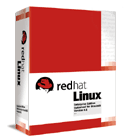
Red Hat High Availability Server is ideal for both small
organizations looking to boost website reliability,
and larger companies and service providers that demand
high levels of availability for their customers.
Easy to afford, set up, and expand - Red Hat High Availability
Server can grow as your business grows.
The Red Hat High Availability Server is an out-of-the-box
clustering solution that delivers dynamic load balancing,
improved fault tolerance, and scalability of IP-based applications.
It is ideally suited to Web servers, ftp servers, VPN gateways,
and front-end IP-based applications where virtually
uninterrupted service is required.
Red Hat High Availability Server lets you combine individual
servers into a cluster, resulting in highly available access to
critical network resources such as data, applications,
and network services. If one server in the cluster fails,
another will automatically take over its workload.
Red Hat High Availability Server can be installed on any
off-the-shelf commodity hardware that supports Linux -
delivering a significant overall cost savings. And it supports
heterogeneous network environments; this means that individual
members of the cluster can run Red Hat Linux or other IP-based
operating systems including Solaris and Windows.
Because it's open source technology, you'll have access to the
source code. View and modify the code as you see fit. You're in
control. Open source also prevents technology lock-in that often
occurs with proprietary solutions, and empowers you to immediately
address problems and security situations.
The Red Hat High Availability Server can be configured in two ways:
- In Failover Services (FOS) mode the system can be configured
as a two-node cold failover cluster, ideally suited for
applications where redundancy is needed such as firewalls,
static Web servers, DNS, mail servers, and the like.
- In Linux Virtual Server (LVS) mode the system can be
configured as an N-node cluster, consisting of a two-node load
balancer attached to any number of clustered servers.
This mode is ideally suited for high-volume Internet infrastructures.
Red Hat High Availability Server includes Standard Hours installation
and configuration support. Support is provided by our worldwide staff
of Red Hat support techicians who can assist in emergencies, or just
help you get your clustering solution running at peak performance.
FEATURES:
Simple, easy setup:
The Red Hat High Availability Server is based on the award-winning Red Hat Linux operating system. From there, our engineers have created a special installation class that installs only those packages that are needed for the clustering solution. The installer then configures the installation for optimal security - saving you time and hassle.
Higher performance and scalability:
The number of nodes in the cluster is limited only by the hardware and network being used. This means that the Red Hat High Availability Server is scalable to meet the growth demands of today's highly dynamic IP environments. The software has advanced cluster features that provide high levels of performance, including the ability to configure servers to bypass the load balancers when returning traffic back to the client, increasing the overall performance of the cluster.
Flexibility:
The Red Hat High Availability Server offers Systems Administrators a high degree of flexibility. In LVS mode the product supports four load-balancing
methods (Round Robin, Weighted Round Robin, Least Connections, and Weighted Least Connections) and three traffic forwarding techniques (IP Masquerading, Tunneling, and Direct Routing). Virtually every popular IP service is supported including Web (http), email, FTP, LDAP, DNS, and others.
Security:
Red Hat High Availability Server has built-in security features designed to withstand common attacks. System administrators can set up sand traps, providing for redirection of IP traffic from a potential attacker to a secure address. Access to normal services is restricted to the High Availability Server by default. In addition, multiple traffic routing and scheduling techniques along with virtual IP addresses allow you to create a security barrier for your network.
Advanced manageability:
Individual nodes can be taken offline for maintenance or upgrades without interruption of service - eliminating costly downtime.
Availability:
The Red Hat High Availability Server dramatically reduces the
likelihood of system failure by quickly detecting component server and application failures and redirecting workload to the remaining servers in the cluster. If one or more servers fail, others take over with minimal interruption.
Excellent value:
Uses inexpensive commodity hardware to lower your overall cost of purchasing and maintaining the system.
|
|




